
The relationship between Rupert Murdoch and Hillary Clinton surprised political observers because the two appeared to represent opposing sides of American politics. Murdoch built a media empire associated with conservative commentary, while Clinton became one of the Democratic Party’s most prominent figures.
Their connection was not a personal alliance based on shared ideology. It was a practical political relationship shaped by New York politics, media access, fundraising, and Murdoch’s long-standing habit of maintaining ties with influential leaders across party lines.
Direct answer: Rupert Murdoch and Hillary Clinton developed a pragmatic political relationship during her years as a New York senator. Murdoch hosted a fundraiser for her 2006 Senate campaign, and the New York Post endorsed her re-election. Their cooperation did not mean they shared the same politics or that Murdoch formally backed her presidential campaigns.
| Key fact | Details |
| Main connection | Political and professional |
| Important period | Early to mid-2000s |
| Major event | Murdoch hosted a 2006 fundraising breakfast. |
| Campaign involved | Clinton’s New York Senate re-election |
| Reported amount raised | More than $60,000 |
| New York Post position | Endorsed Clinton for Senate re-election |
| Presidential endorsement | Murdoch said an endorsement was unlikely. |
| Shared ideology | No; their views differed on many issues. |
Key Takeaways
- Murdoch hosted a fundraising event for Clinton’s 2006 Senate campaign.
- The breakfast reportedly raised more than $60,000.
- His New York Post supported her Senate re-election after years of hostile coverage.
- Their relationship was based more on political access and mutual advantage than shared beliefs.
- Murdoch did not become a reliable Democratic supporter.
- His media organizations continued to include strong conservative voices.
- The episode illustrates how media power and political influence can cross party lines.
Rupert Murdoch and Hillary Clinton: What Was Their Connection?

Their most visible connection emerged while Clinton represented New York in the United States Senate. Rupert Murdoch and Hillary Clinton News Corporation, whose American holdings included Fox News and the New York Post. Both outlets had been sharply critical of Bill and Hillary Clinton during the 1990s. That history made Murdoch’s later cooperation with the senator especially newsworthy.
The relationship changed gradually rather than through one sudden agreement. Clinton and her staff maintained contact with Post journalists, despite the newspaper’s earlier attacks. The paper began treating her work as a New York senator more favorably. Its editor, Col Allan, later said he had developed respect for her work ethic and attention to constituents.
Murdoch also developed warmer relations with former President Bill Clinton. Those contacts helped create a less hostile environment between the Clinton family and parts of News Corporation.
The 2006 Fundraising Breakfast
The clearest example of cooperation took place on July 17, 2006. Murdoch hosted a fundraising breakfast for Clinton at News Corporation’s midtown Manhattan headquarters. The building also housed Fox News and the New York Post. Several senior company figures attended, including Fox News chief Roger Ailes and Post editor Col Allan. Clinton spoke for about 20 minutes and answered questions from those present.
The event raised more than $60,000 for her Senate re-election campaign, according to a detailed New Yorker account published later that year. Neither Ailes nor Allan reportedly donated at the breakfast.
The event attracted national attention because Murdoch was widely viewed as a conservative power broker. Fox News had become a major platform for Republican viewpoints, while Clinton was preparing for an easy Democratic Senate victory and considering a future presidential campaign.
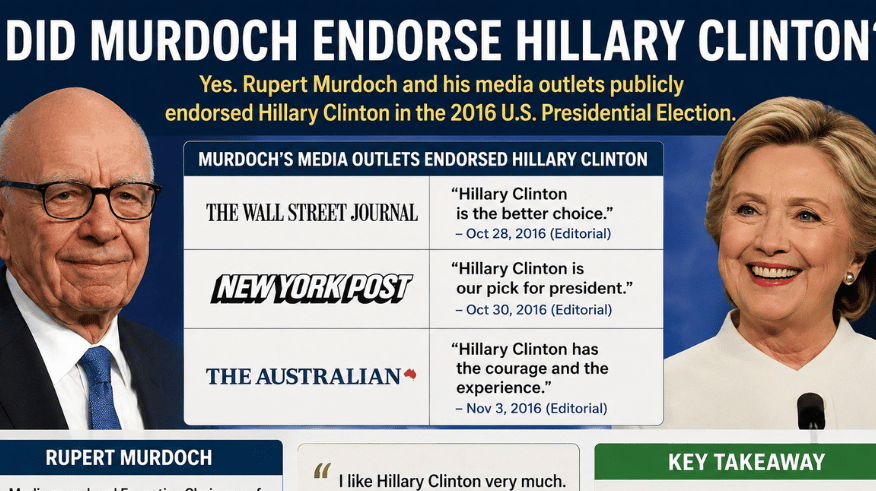
Did Murdoch Endorse Hillary Clinton?

Murdoch’s New York Post endorsed Clinton in her 2006 Senate re-election race. That support carried symbolic weight because the newspaper had attacked her repeatedly during her first Senate campaign. One analysis of its 2000 coverage counted far more negative pieces than positive ones. By 2006, its treatment of her had become noticeably less hostile.
Still, support for her Senate campaign should not be confused with an unrestricted personal endorsement. When asked in July 2006 whether he might support her expected 2008 presidential campaign, Murdoch said such an endorsement was unlikely. His answer showed that he wanted to keep his options open rather than commit himself to Clinton’s national ambitions.
The Post’s support was also not permanent. Later political developments changed Murdoch’s calculations, as they often did throughout his career.
Why Would a Conservative Media Owner Support a Democrat?
Murdoch’s political activity has rarely followed a simple left-versus-right formula.
He supported conservative leaders such as Margaret Thatcher and Ronald Reagan. Yet his newspapers also backed Australian Labor politicians and Britain’s Tony Blair when Murdoch believed they represented political change or future influence.
His approach often combined several considerations:
- A politician’s likelihood of gaining or retaining power
- The politician’s relationship with his businesses
- Access to decision-makers
- Regional political conditions
- The views of individual newspaper editors
- Murdoch’s personal judgment about leadership
In New York, Clinton had become a powerful incumbent senator. The state Republican Party had struggled to produce a competitive challenger. Building a working relationship with her gave Murdoch and his executives access to an important elected official. Clinton also benefited. Better relations reduced the hostility coming from one of New York’s most aggressive newspapers. The arrangement offered value to both sides without requiring either one to change political identity.
Bill Clinton’s Role in the Relationship
Bill Clinton helped improve relations between the family and Murdoch’s organization.
The former president reportedly sought a meeting with the media executive after moving to New York. The two eventually met for a lengthy lunch in 2002 and developed a cordial relationship.
Murdoch later praised Bill Clinton’s intelligence, knowledge, and personal charm. News Corporation also donated $500,000 to the Clinton Climate Initiative, according to the New Yorker.
Bill Clinton’s contacts with Murdoch had a practical benefit for his wife. They helped soften the previously antagonistic relationship between her and the New York Post.
A Clinton spokesman explained the approach in straightforward terms: political disagreement did not prevent cooperation on selected issues. That principle helps explain why the relationship appeared warmer than their ideological differences might suggest.
Did Fox News Become Supportive of Clinton?
No. Murdoch’s dealings with the Clintons did not transform Fox News into a pro-Clinton network.
Fox continued to employ prominent conservative hosts and commentators. Its audience and commercial identity were strongly connected to conservative political coverage.
Murdoch also faced limits on how far he could shift the tone of his media properties. Editors, executives, presenters, and audiences had their own expectations. Some publications within his company had formal or practical editorial independence.
The New York Post’s more favorable treatment of Clinton therefore did not prove that every Murdoch-owned outlet had adopted the same position. This distinction matters. A media owner’s relationship with a politician can affect access, editorial tone, or institutional strategy without producing identical coverage across every publication and television channel.
Was the Relationship a Secret Political Alliance?
There is no strong evidence that they formed a secret ideological partnership. The known interactions were widely reported. They included meetings, a publicized fundraiser, improved newspaper coverage, and cooperation involving Bill Clinton’s charitable initiatives.
It is more accurate to describe the relationship as strategic and transactional in the ordinary political sense. Both sides understood the other’s influence. Murdoch wanted connections with leaders who could shape public policy. Clinton wanted fairer treatment and access to audiences reached by his media organizations.
That does not prove improper coordination. Politicians regularly build relationships with media executives, donors, business leaders, unions, campaign groups, and advocacy organizations. The important issue is not that contact occurred. It is how concentrated media ownership can give a small number of executives unusual access to political leaders.
What Happened During the 2008 Presidential Race?

Murdoch did not become a dependable Clinton supporter during the 2008 Democratic presidential contest. His views and the positions taken by his media organizations shifted as the campaign developed. The New York Post ultimately endorsed Barack Obama in the Democratic primary.
This change reinforced a central feature of Murdoch’s political style: support could move from one candidate to another when circumstances changed.
The 2006 fundraiser had led commentators to ask whether he was preparing to support Clinton for president. His later actions showed that the event was not a permanent commitment.
Why Does the Story Still Matter?
The story remains relevant because it shows that relationships between media owners and politicians are often more complicated than public party labels suggest.
A conservative media executive may maintain good relations with a Democrat. A Democratic politician may seek support from an organization that frequently carries conservative commentary.
Those relationships can serve several purposes:
- Securing interviews and access
- Reducing hostile coverage
- Influencing policy discussions
- Building ties with potential officeholders
- Protecting business or political interests
- Preserving options before an election
Readers should avoid treating every meeting or donation as proof of ideological agreement. They should also avoid dismissing such relationships as meaningless. Media access can affect which politicians receive attention, how their actions are framed, and whether criticism is amplified or softened.
Final Takeaway
Rupert Murdoch and Hillary Clinton: Murdoch hosted a fundraiser for Clinton, while his New York newspaper endorsed her Senate re-election. In return, he maintained access to a powerful senator and possible presidential contender. Clinton gained a less hostile relationship with an influential media organization.
Their cooperation is best understood as political pragmatism. It shows how power, media access, business interests, and electoral strategy can bring unlikely figures together, even when their public political identities remain far apart.
Frequently Asked Questions
They had a cordial political and professional relationship, but available reporting does not establish a close personal friendship. Their contact was mainly connected to politics, media, fundraising, and Bill Clinton’s initiatives.
Murdoch hosted a July 2006 fundraising breakfast for her Senate campaign. The event raised more than $60,000. Reports about the breakfast focus on his role as host rather than identifying a personal donation from him.
Fox News does not issue endorsements in the same way a newspaper editorial board does. The Murdoch-owned New York Post endorsed her 2006 Senate re-election campaign.
The paper’s leadership cited her work as a New York senator, including her constituent service and political effectiveness. The weak Republican opposition in the state also shaped the wider political context.
He never gave her a firm presidential endorsement. Soon after the 2006 fundraiser, he said such an endorsement was unlikely. The Post later backed Barack Obama during the Democratic primary.
It reveals how political influence can cross ideological boundaries. Media owners and politicians may cooperate for access, visibility, policy influence, or strategic advantage without agreeing on most political issues.

