

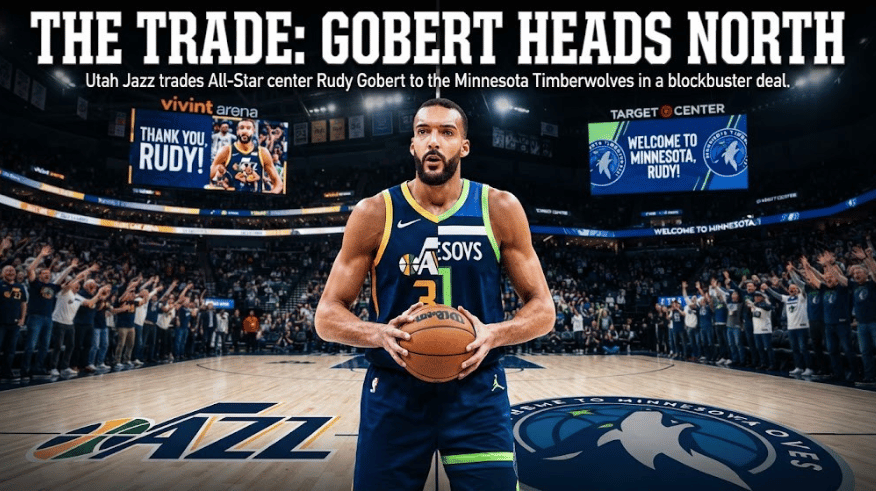
The Rudy Gobert trade sent the three-time Defensive Player of the Year from the Utah Jazz to the Minnesota Timberwolves in July 2022. Minnesota surrendered five players, four future first-round picks, and a first-round pick swap. The price looked excessive at first, but several deep playoff runs have changed how the deal is judged.
| Key detail | Information |
| Trade announced | July 2022 |
| Timberwolves received | Rudy Gobert |
| Jazz received | Five players, four first-round picks and one pick swap |
| Main player sent to Utah. | Walker Kessler |
| Minnesota’s major result | Consecutive Western Conference Finals appearances in 2024 and 2025 |
| Gobert’s major individual result | 2023–24 Defensive Player of the Year |
| Current verdict | Minnesota achieved its goal, while Utah retained long-term asset value. |
Direct answer: Minnesota paid a historic package for Gobert, but the move helped create the most successful sustained period in Timberwolves history. Utah gained valuable prospects and draft capital, yet Minnesota has received the clearer on-court return. Based on results through July 2026, the Timberwolves have the stronger case for winning the deal.
What Was Included in the Rudy Gobert Trade?

The Timberwolves acquired Rudy Gobert in a trade from Utah after the 2021–22 season. Minnesota wanted an elite rim protector who could improve its defense and support a young core led by Anthony Edwards. According to the NBA’s official transaction report, the full exchange was as follows.
Minnesota Timberwolves received
- Rudy Gobert
Utah Jazz received
- Malik Beasley
- Patrick Beverley
- Leandro Bolmaro
- Jarred Vanderbilt
- The draft rights to Walker Kessler
- Minnesota’s 2023 first-round pick
- Minnesota’s 2025 first-round pick
- A 2026 first-round pick swap
- Minnesota’s 2027 first-round pick
- Minnesota’s 2029 first-round pick
Rudy Gobert Trade: The 2029 selection included top-five protection. Most of the other major draft assets were sent without the strong protections teams often place on distant picks. That volume made the deal unusual. Minnesota wasn’t trading for a dominant scorer or primary ball handler. It was paying a superstar-level price for defense, rebounding, screening, and interior efficiency.
Why Did Minnesota Make Such an Expensive Deal?
The Timberwolves believed their young roster was ready to accelerate its timeline. Edwards had already shown signs of becoming a franchise player, while Karl-Anthony Towns remained an established All-Star.
Gobert offered skills that the roster lacked:
- Elite rim protection
- Defensive rebounding
- Interior size
- Strong screening
- Efficient finishing near the basket
- Regular-season durability
The front office also believed Towns could spend more time at power forward. That plan was supposed to reduce his defensive responsibilities around the rim. The immediate fit was uneven. Minnesota struggled to create spacing with two traditional big men, and Gobert needed time to develop chemistry with his new teammates. The Wolves finished the 2022–23 campaign as a playoff team but lost in the first round.
That difficult first season fueled claims that Minnesota had made one of the worst trades in league history. Those judgments proved premature. Readers interested in another defensive star’s career can also explore Worthxyra’s guide to Kawhi Leonard’s injuries and NBA journey.
How Gobert Changed the Timberwolves
Minnesota’s return became easier to see during the 2023–24 season. The Timberwolves finished 56–26, their second-best regular-season record at that time. They also produced the NBA’s top-ranked defense. Gobert averaged 14 points, 12.9 rebounds and 2.13 blocks while shooting 66.1% from the field.
His performance earned him a fourth Defensive Player of the Year award. He joined Dikembe Mutombo and Ben Wallace as the only four-time winners in the award’s history. Minnesota then swept the Phoenix Suns and defeated the defending champion Denver Nuggets in seven games.
The team advanced to the Western Conference Finals for only the second time in franchise history. The Wolves returned to the conference finals in 2025. Before Gobert’s arrival, Minnesota had advanced beyond the first round only once.
With him anchoring the defense, the franchise reached the West finals in consecutive seasons. Those results don’t prove that every asset surrendered was insignificant. They do show that Minnesota received what it wanted: a dependable defensive identity and a genuine championship window.
What Did Utah Get From the Deal?

Utah’s return should be separated into three groups: players, drafted prospects, and future selections.
| Asset group | Main return | Long-term outcome |
| Veteran players | Beasley, Beverley, and Vanderbilt | Most were moved in later transactions |
| Young players | Kessler and Bolmaro | Kessler became the most valuable original player asset |
| Draft capital | Picks in 2023, 2025, 2027, and 2029, plus a 2026 swap | Some picks remain important future assets |
| Later returns | Extra assets obtained by trading original pieces | Utah extended the value of the package |
Walker Kessler
Kessler became the centerpiece of Utah’s initial player return. The 22nd pick in the 2022 draft quickly developed into a productive rebounder and shot blocker. His early success made the deal look worse for Minnesota. During Gobert’s difficult first year, Utah appeared to have found a younger and cheaper replacement.
Utah later agreed to send Kessler to the Los Angeles Lakers in a 2026 sign-and-trade. Reuters reported that the Jazz received unprotected 2031 and 2033 first-round picks, along with pick swaps in 2028 and 2030. That transaction means Kessler’s value did not disappear when he left Utah. It was converted into another collection of long-term assets.
Keyonte George and Walter Clayton Jr.
Utah used the 2023 pick connected to the deal to select Keyonte George. The guard showed scoring and playmaking potential during his first NBA season. The 2025 selection also helped Utah move into position to draft Walter Clayton Jr. These players gave the Jazz additional chances to build a younger roster.
Sports Illustrated’s three-year review concluded that Minnesota was ahead because Gobert had already produced major team results. It also noted that Utah could improve its side of the deal through player development and its remaining picks.
Did Minnesota Overpay?

Minnesota almost certainly paid more than Gobert’s conventional trade value in 2022. Four first-round selections, a swap, and five players would usually be associated with a younger offensive superstar.
Yet an overpayment and a successful transaction can coexist. A trade should be evaluated against the acquiring team’s goal. Minnesota wasn’t trying to collect flexible assets. It wanted to turn a promising roster into a contender while Edwards was developing.
The deal helped produce:
- A league-leading defense
- A 56-win season
- Gobert’s fourth Defensive Player of the Year award
- Two consecutive Western Conference Finals appearances
- Greater postseason experience for Edwards and the supporting cast
Minnesota paid a premium for certainty. Utah accepted short-term uncertainty in return for several opportunities to draft, develop, or trade for future talent.
For more athlete-focused coverage, visit Worthxyra’s profile of Colin Strickland’s career and sporting background.
Who Won the Trade?
The current verdict favors Minnesota, although Utah did not lose in the traditional sense. The Timberwolves acquired a player who transformed their defensive identity and helped the franchise reach heights it had rarely achieved. That is a concrete return rather than a theoretical one.
Utah gained a large pool of assets. Some original players produced little direct value, but Kessler became a productive center and was later converted into more draft capital. The Jazz also retained picks that could become more valuable as Minnesota’s roster ages.
The two teams were pursuing different objectives:
- Minnesota wanted immediate contention.
- Utah wanted flexibility and rebuilding assets.
- Minnesota has already achieved major competitive results.
- Utah’s final return cannot be measured until the remaining selections are used.
For now, Minnesota’s results carry more weight. A team that had reached the conference finals once before the deal advanced that far in both 2024 and 2025. Gobert also added another major individual award during that period.
The trade was expensive. It was not the disaster many observers predicted.
What the Deal Teaches About NBA Trade Value

The transaction shows why a trade package cannot be judged only by counting draft picks. A future first-round selection has uncertain value. It could produce a star, a rotation player, or someone who never becomes a regular contributor. A proven veteran offers less flexibility but more predictable performance.
Minnesota chose the predictable impact of an established defender. Utah chose several uncertain opportunities with a higher range of possible outcomes.
The most useful way to assess similar deals is to ask three questions:
- Did the acquired player solve the team’s main problem?
- Did the move help the team reach a level it was unlikely to reach otherwise?
- Did the selling team create enough chances to build its next competitive roster?
Minnesota can answer yes to the first two. Utah’s answer to the third will depend on how its remaining picks and later returns develop. Visit Worthxyra for more profiles covering athletes, entertainers, and other notable public figures.
Final Takeaway
The deal began as a symbol of reckless spending. Four years later, it looks more like an aggressive move that accomplished its main purpose. Rudy Gobert trade: Minnesota surrendered flexibility and a huge number of assets. In return, it gained the defensive foundation for the franchise’s strongest sustained playoff period.
Utah collected valuable rebuilding tools and continued converting them into future opportunities. The fairest judgment is that both teams received something they needed. Still, Minnesota has the better result so far because its return has already changed the franchise’s competitive history.
Frequently Asked Questions
Minnesota acquired him in July 2022. The teams formally announced the transaction on July 6.
The package included four first-round picks in 2023, 2025, 2027, and 2029. Utah also received the right to swap first-round positions with Minnesota in 2026.
The player package included Malik Beasley, Patrick Beverley, Leandro Bolmaro, Jarred Vanderbilt, and the draft rights to Walker Kessler.
No. That label became difficult to defend after Minnesota built a top-ranked defense and reached consecutive Western Conference Finals. The cost was high, but the deal produced meaningful results.
Yes. He won the 2023–24 Defensive Player of the Year award, the fourth such honor of his career.
Not yet. Some draft assets and later returns remain unresolved. Utah’s eventual value could change depending on how those selections develop.
Minnesota leads the evaluation because it has already received elite defense and sustained playoff success. Utah still has enough future assets to make the transaction beneficial for its rebuild.

