


Ken Griffin and Paul Singer are billionaire investors who built two of Wall Street’s most influential firms. Griffin is considerably wealthier, with Forbes estimating his Fortune at $57.5 billion in July 2026. Singer’s estimated net worth was $6.7 billion at the same point. Their careers also reflect different approaches to investing, business growth, risk, and corporate influence. For a closer look at this, see Rafael Nadal and David Cordani.
Griffin built Citadel into a large, technology-driven, multi-strategy investment firm and also founded Citadel Securities. Singer created Elliott Management, which became known for activist investing, distressed debt, and campaigns seeking changes at major companies.
| Key detail | Ken Griffin | Paul Singer |
| Estimated net worth | $57.5 billion | $6.7 billion |
| Main firm | Citadel | Elliott Management |
| Firm founded | 1990 | 1977 |
| Current main role | Founder, CEO and co-CIO | Founder, president, co-CEO and co-CIO |
| Main investing reputation | Multi-strategy investing and quantitative analysis | Activist investing and distressed debt |
| Education | Harvard University | University of Rochester and Harvard Law School |
| Estimated age in July 2026 | 57 | 81 |
Net-worth figures are Forbes estimates as of July 20, 2026. They can change with asset values, business valuations, investments, taxes, and liabilities. – Griffin’s estimated fortune is almost eight times Singer’s estimated wealth.
- Both men built self-made fortunes through hedge fund management.
- Citadel developed into a broad multi-strategy investment business.
- Elliott became closely associated with activist and distressed investing.
- Both investors have made large political and philanthropic contributions.
- Published net-worth totals are estimates, not audited personal statements.
Who is Ken Griffin?

Kenneth C. Griffin is the founder, chief executive officer, and co-chief investment officer of Citadel. He is also the founder and non-executive chairman of Citadel Securities, a separate market-making business. Griffin became interested in finance while studying at Harvard University. According to Citadel’s official biography, investing was first undertaken from a Harvard dorm room in 1986. He launched a small hedge fund the following year and established Citadel in 1990, shortly after graduating beyond its early convertible-bond strategy.
Citadel now invests through several teams and asset classes, supported by quantitative research, technology, data, and risk controls. Its official website reported $71 billion in investment capital as of July 1, 2026. It is connected to his ownership interests in both Citadel and Citadel Securities. Forbes described Citadel Securities as one of Wall Street’s largest market makers and reported that it handles about one-quarter of stock trades in the United States. Ger?
Paul Singer
Paul Singer is the founder, president, co-chief executive officer, and co-chief investment officer of Elliott Management. The firm was founded in 1977, and its investment, risk, valuation, and management committees continue to be supported through his ongoing involvement. He earned a psychology degree from the University of Rochester before completing a law degree at Harvard. His legal training became relevant to Elliott’s reputation for detailed research, complex negotiations, creditor disputes, and long-running investment campaigns.
The firm operates across several asset classes but is best known publicly for activist campaigns and distressed-debt investments. The firm may purchase a stake in a company and then seek changes in management, operations, strategy, capital allocation, or governance. One of Singer’s most widely reported investments involved Argentine government debt. Forbes says Elliott’s dispute with Argentina lasted 15 years and resulted in a $2.4 billion payment to the firm in 2016. Paul Singer net worth comparison
The gap may instead reflect several factors:
- Griffin’s ownership interests in two major financial businesses
- Citadel’s scale and long-term profitability
- However, the estimated value of Citadel Securities
- Differences in ownership structure
- Each founder’s retained earnings and outside investments
- Private debts, taxes, charitable giving, and estate planning
Because both firms are privately held, outsiders cannot calculate either founder’s finances with complete precision.
How Ken Griffin and Paul Singer’s Investment Approaches Differ
The strongest contrast between the two investors is not their wealth. It is how their firms seek returns.
Citadel’s multi-strategy model
Citadel operates as a large alternative investment firm with teams working across equities, fixed income, commodities, credit, and quantitative strategies. Overall, Capital can be allocated across strategies based on risk, opportunity, and market conditions.
The model depends on technology, data, specialist teams, and centralized risk management. Additionally, it also requires substantial spending on recruitment, infrastructure, research, and computing. Griffin has described talented portfolio managers and other investment professionals as scarce resources. Whether the hedge fund industry’s competition for talent is as permanent as some firms suggest has been questioned by Singer.
Their contrasting views reflect the different structures and staffing demands of their organizations—Vist model. However, Elliott is associated more closely with concentrated situations where the firm believes an asset, company, or security is mispriced. Moreover, its teams may examine corporate governance, management decisions, debt agreements, strategic alternatives, or underperforming divisions.
The firm can then push for changes intended to raise shareholder value or improve creditor recoveries. Additionally, this approach can involve public letters, private negotiations, board nominations, litigation, restructuring talks, or proposed asset sales. Campaigns may be conducted over a period of months or years.
Their political influence
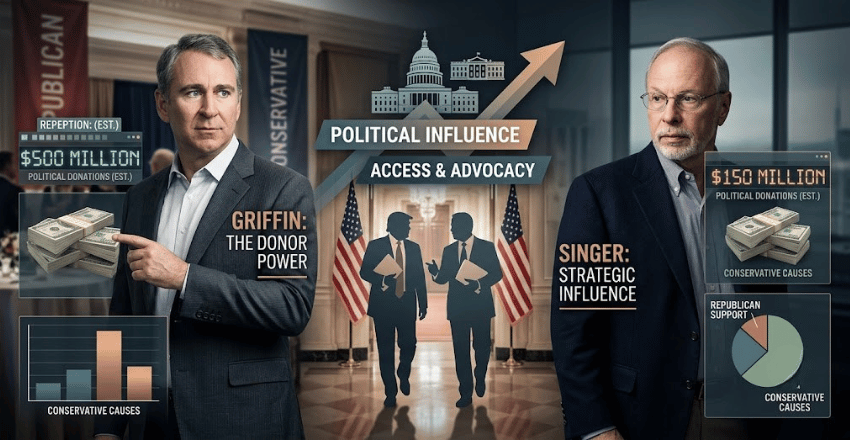
Both investors have supported Republican candidates and conservative causes, although neither has backed every Republican leader or policy. In 2024, Fortune reported that both men met separately with Donald Trump while considering support for his presidential campaign. The report noted that each had criticized Trump in the past. Giving has continued to attract attention because large donations can provide wealthy individuals with access and influence.
A 2025 Washington Post analysis estimated Griffin’s total political donations at about $500 million and Singer’s at about $150 million over the periods examined. Moreover, numbers can change, and a contribution does not prove agreement with every position taken by a candidate or party.
Philanthropy and charitable giving

Both financiers have directed part of their wealth toward nonprofit organizations. Citadel’s official biography states that Griffin has donated more than $2.5 billion. His giving has supported education, medical research, cultural institutions, economic opportunities, and civic projects. Singer has contributed roughly $300 million to his foundation since 2010. His charitable work has included Jewish organizations, pro-Israel causes, public-policy groups, and other nonprofit projects.
Large fortunes may also find Worthxyra’s explanation of [how public net-worth estimates should be interpreted] useful. The site notes that private liabilities, taxes, contracts, investments, and ownership arrangements are rarely disclosed in full. lies in that cautious approach in its profiles of [Usher’s income and business ventures] and [Jermelle Simon’s unverified wealth estimates]. Overall, has it had a greater financial impact?
The answer depends on the form of impact being measured.
Griffin has built the larger estimated personal fortune; Citadel has also achieved enormous scale, while Citadel Securities plays a major role in modern financial-market infrastructure. Singer’s influence is often more visible at individual companies. Elliott’s campaigns can affect boards, executives, asset sales, mergers, capital returns, and corporate strategy.
The clearest verdict is that Griffin leads by personal wealth and organizational scale, while Singer is more closely identified with shareholder activism and complex distressed investments. Both have shaped Wall Street, but they have done so through different business models.
Conclusion
Additionally, Ken Griffin and Paul Singer represent two distinct routes to hedge fund success. One built a broad, technology-intensive investment platform and a major market-making company. Overall, the other became known for activist campaigns, distressed securities, and persistent negotiations.
However, Griffin has the larger estimated fortune by a wide margin. Singer’s smaller personal total does not reduce Elliott’s importance or his influence on corporate decision-making. Together, their careers show that Wall Street power can come from scale, infrastructure, specialized research, legal strategy, or a combination of those strengths.
If you want to know about John Stankey and John Paulson then visit our Business category.
Frequently asked questions
Griffin is richer based on current public estimates. Forbes placed his wealth at $51.7 billion and Singer’s at $6.7 billion on July 20, 2026. Is Griffin?
The difference between the two Forbes estimates is approximately $45 billion. Griffin’s estimated fortune is about 7.7 times larger.
No. Both firms invest across more than one strategy, but Citadel is known for its large multi-strategy platform. Elliott is more closely associated with activist investing and distressed opportunities.
Forbes assigns both men a self-made score of eight out of ten. Griffin founded Citadel in 1990, while Singer established Elliott in 1977. Are Paul Singer and Griffin business partners?
There is no public evidence that they are business partners. They lead separate investment firms and sometimes appear in the same financial or political news because both are major hedge fund founders and donors.
No. The figures are estimates based on available information about business ownership, investments, assets, and other financial factors. Overall, private liabilities and ownership arrangements may not be publicly known.